Building Smarter on BC’s Coastline: What Green Shores Means for Coastal Homes
Building along the Sunshine Coast has always required an enhanced level of care and foresight, and it’s a landscape that could be described as challenging. Not only is one side of the Sunshine Coast mountainous, rocky and steep, the other side is made up of a beautiful coastline, that is important to protect. More recently, that need has only increased as coastal conditions continue to change.
Lincoln Construction Project Coordinator Maria Rangwala recently attended a UVic affiliated Green Shores workshop focused on coastal building, shoreline management, and climate-related change. The training explored how shorelines are evolving, how regulations are shifting, and how BC-based builders can work more closely with natural systems rather than relying solely on traditional hard infrastructure. As part of this work, Maria has now completed her Green Shores Level 1 Certification, which has strengthened our in-house coastal building knowledge.
“Attending the Green Shores workshop was eye-opening, it showed how low-tech, nature-based tools like native plants, logs, and natural contours can provide resilient protection without fighting the environment. Nature really is the best answer to nature’s challenges; by working with coastal processes instead of against them, we create shorelines that adapt, endure, and support healthier ecosystems for the long term.”
Below are some of the key learnings from the workshop, and why they matter for homeowners building or renovating near the water.
Why Coastal Knowledge Matters to Lincoln Construction
Coastal environments are changing faster than many inland areas. On the Sunshine Coast and throughout BC, rising sea levels, more frequent king tides, and increasingly intense storm events are putting greater pressure on shoreline homes. Erosion and flooding are no longer rare or isolated concerns and are unfortunately becoming part of standard planning considerations for coastal properties.
Building near the water now requires informed, shoreline-specific knowledge. Homeowners that don’t take these changes into account can face higher maintenance demands, unexpected permitting challenges, or long-term performance issues. Thoughtful coastal planning has become an essential part of responsible building, especially if you’re building a home to last generations.
What Green Shores Is and Why It’s Useful
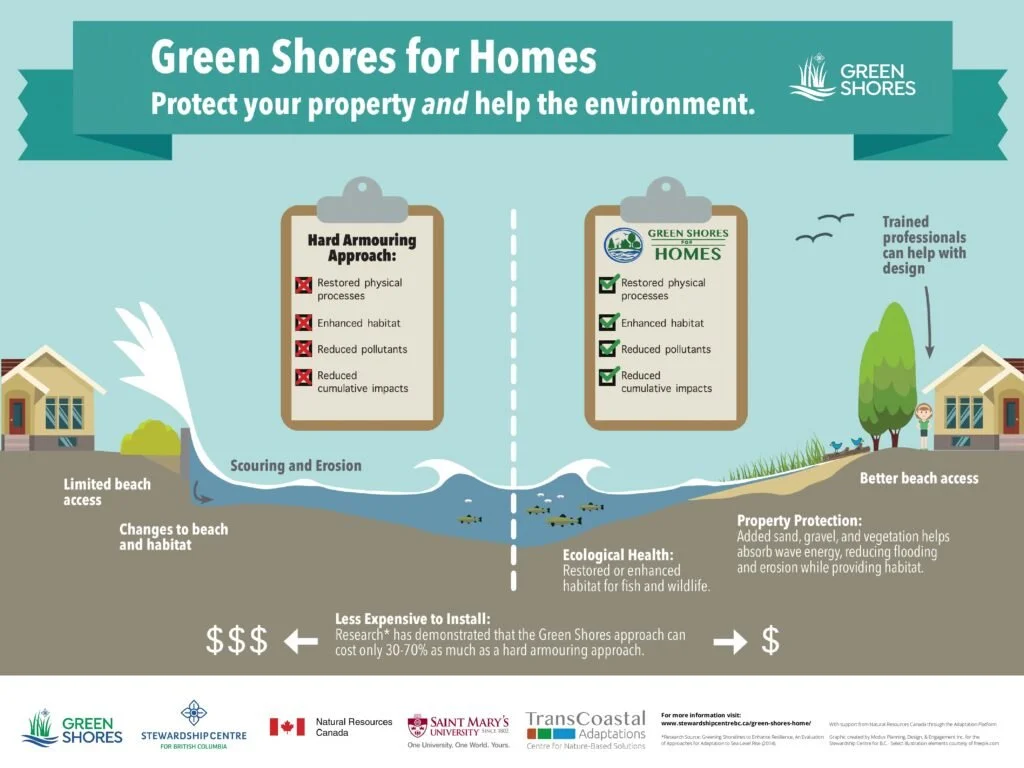
Green Shores is a program that promotes nature-based shoreline solutions as an alternative to traditional seawalls and hard armouring (Hard armouring refers to conventional, rigid structures like seawalls, bulkheads, and riprap used to stop shoreline erosion), Instead of relying entirely on concrete or rock, Green Shores encourages approaches that use natural materials such as native plants, logs, sand, and gravel, sometimes combined with engineered elements where appropriate.
These naturally sourced and engineered systems are designed to work with coastal processes rather than against them. By absorbing wave energy and allowing shorelines to adapt naturally over time, Green Shores designs help protect homes while also supporting healthier ecosystems. The nature-based shoreline solutions aim to protect property and habitat at the same time, rather than sacrificing one for the other.
Moving Away from Hard Seawalls
For many years, continuous rock or concrete seawalls were considered the standard solution for shoreline protection. However, under today’s conditions, these approaches are often proving less effective. Hard seawalls tend to reflect wave energy rather than absorb it, which can increase erosion nearby and reduce the natural movement of beaches.
Nature-based and hybrid shoreline designs perform differently. They dissipate wave energy more gradually and are better able to adapt to changing water levels and storm intensity. As a result, regulatory bodies are increasingly encouraging softer shoreline approaches, and in many cases, these designs are easier to permit than traditional hard armouring.
Why Salmon Habitat Matters for Coastal Construction
Though not the first thought for many when considering a coastal build, shoreline construction has a direct impact on salmon habitat, which plays a significant role in how waterfront projects are reviewed and approved. Hard shoreline modifications can reduce shallow nearshore areas, eliminate natural shade, and disrupt beach systems that juvenile salmon rely on, which can have a negative effect on local salmon stocks.
Because of these impacts, the Department of Fisheries and Oceans (DFO) now place tighter restrictions on hard shoreline structures. Green Shores approaches are specifically designed to improve habitat conditions while still providing effective shoreline protection, helping projects align with both environmental and regulatory expectations.
What This Means for Our Clients
For homeowners building or renovating on the coast, this knowledge leads to better outcomes. Green Shores informed design can:
Reduce long-term maintenance demands,
Improve resilience to future climate conditions
Save a significant amount of cost in materials as nature-based solutions are generally far more cost-effective than hard armouring
Help projects move more smoothly through the permitting process.
These approaches can also enhance property value and design appeal by creating shorelines that feel more natural and integrated with their surroundings, rather than huge concrete block structures that can look unsightly and unorganic.
Because Green Shores relies on naturally available materials, there can be a noticeable cost difference compared to traditional seawalls. However, that difference often reflects longer-term durability and reduced intervention over time.
This training is part of Lincoln Construction’s ongoing investment in coastal expertise, ensuring that waterfront homes are designed with both current conditions and future changes in mind.
Looking Ahead
Coastal building is changing quickly. By 2050, significant environmental shifts are expected to be clearly visible along BC’s coastlines, including right here on the Sunshine Coast, particularly noticeable with sea-level rise. Staying ahead of those changes means continuing to deepen our understanding of shoreline systems, regulations, and best practices.
Green Shores training is one way Lincoln Construction is preparing for that future: Building smarter, more resilient homes that respect the coastline and habitats they’re built on.