Building for the Long Term: How Good Homes Age Well
A well-built home should hold up over time and feel like it’s working for you, not against you. On the Sunshine Coast, homes deal with a lot: long wet seasons, salty air, shifting temperatures, and more recently, increasingly unpredictable weather patterns. Over the years, we’ve seen homes that handle these conditions quietly and reliably, and others that start to show signs of stress much earlier than expected.
What separates the two usually isn’t what you see at the end but it’s the decisions made early on, before construction even begins.
Why Minimum Code Isn’t Quite Enough
Building code is there for a reason. It sets a baseline for safety and performance, and in BC, the Step Code has pushed things forward in terms of energy efficiency. What we’re seeing now, especially with climate patterns shifting, is that building to minimum code doesn’t always prepare a home for what’s coming. Wetter winters, hotter summers, and rising energy costs are all part of the equation.
So, while Step Code has raised the bar, many homeowners are choosing to go a little further, not for the sake of it, but because it tends to make sense over time.
That might mean:
Lower monthly energy costs
More consistent indoor comfort
Fewer upgrades or fixes down the line
It’s less about building something “high-performance” on paper, and more about building something that actually feels good to live in, year after year.
What This Looks Like in Practice
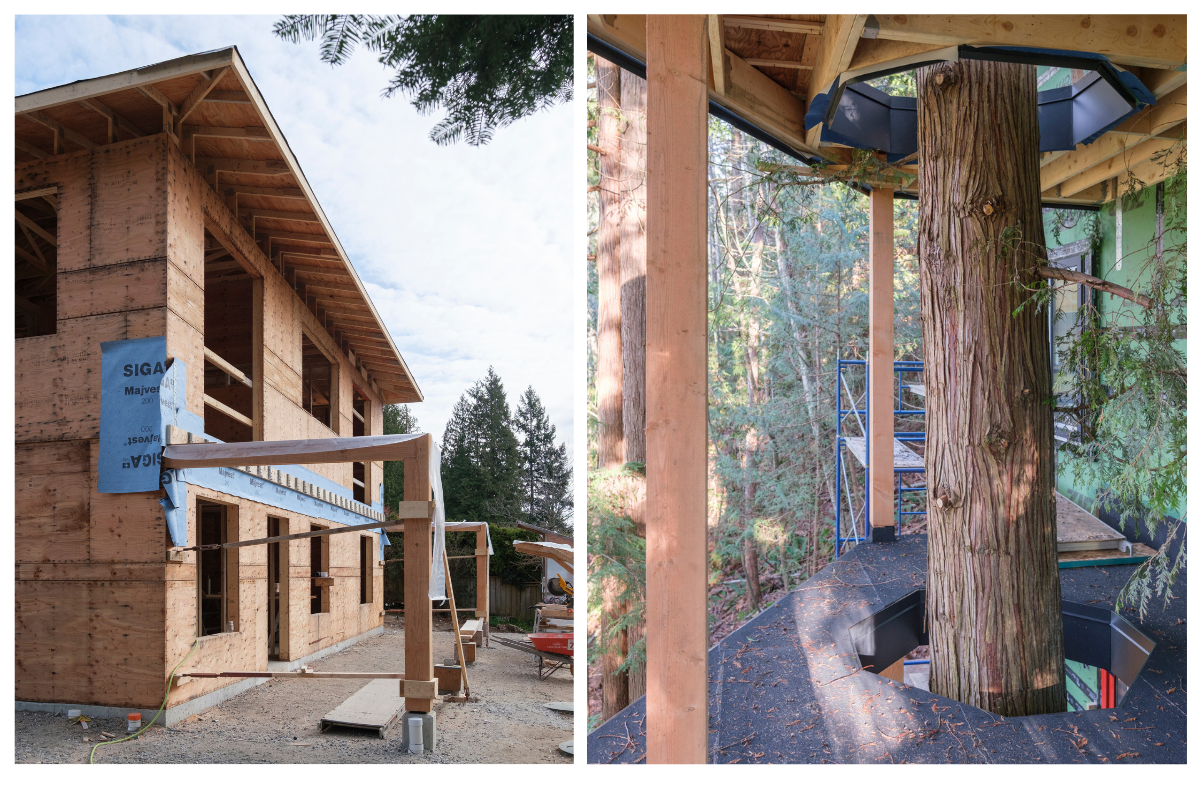
On a recent high-performance build on the Sunshine Coast The Conifers (that was later recognized for its sustainability) a lot of these decisions came into play early.
The home was designed to operate with extremely low energy demand, using a super-insulated building envelope, high-performance windows, and an airtight construction approach. Instead of relying heavily on heating systems, the home holds its temperature naturally, even during colder months.
Because of the coastal environment, moisture control was a major focus. The wall assemblies, ventilation strategy, and detailing were all designed to manage moisture consistently, rather than react to it after the fact. The result is a home that doesn’t just meet current standards, but it performs comfortably and efficiently day-to-day, with very little fluctuation, even as outdoor conditions change. That kind of outcome doesn’t come from one decision, it’s the accumulation of many small ones made early.
High-Performance Building, Explained (Without the Jargon)
At its simplest, a high-performance home is one where everything works together. The walls, windows, roof, and foundation are designed to keep heat in when it’s cold, keep heat out when it’s warm, and manage air and moisture in a controlled way.
When that’s done well, a few things happen:
The temperature inside stays more consistent
There are fewer drafts or cold spots
The home feels quieter and more settled
From there, mechanical systems (things like ventilation and heating) don’t have to work as hard. They become more about fine-tuning comfort rather than compensating for gaps in the build. Most homeowners don’t ask for “airtightness levels” or “energy recovery systems.” They’re usually just looking for a home that feels comfortable and doesn’t come with constant adjustments. That’s really what this approach is about.
Materials That Actually Hold Up Here
Building on the coast means accepting that moisture is part of the environment, not something you can completely avoid. So the goal isn’t to fight it, but to manage it properly.
That shows up in a few key ways:
Rainscreen systems that allow walls to dry out
Proper ventilation in roof and wall assemblies
Materials that can handle getting wet and drying repeatedly
We’ve seen what happens when this isn’t done well, siding that deteriorates too quickly, trapped moisture that leads to bigger issues, and homes that require more maintenance than expected. On the other hand, when materials are chosen and detailed properly, they tend to age more naturally. Cedar, for example, weathers over time but continues to perform. Metal roofing holds up well in heavy rain. Simple, durable finishes often outlast more complex ones.
Homes That Still Perform Years Later
One of the things we think about a lot is how a home will feel five, ten, even twenty years down the line, not just structurally, but functionally.
Does the layout still make sense as life changes?
Can spaces be used differently over time?
Is the home still comfortable without constant upgrades?
These aren’t always the first questions people ask, but they tend to matter more as time goes on. We’re also seeing more buyers pay attention to performance, such as energy use, comfort, durability, not just finishes. Homes that are built with those things in mind tend to hold their value a bit differently.
Building Once, Building Well
There’s a noticeable difference between homes that are built to get through a project, and homes that are built to hold up over time. At Lincoln Construction, a lot of the focus is on getting things right early, working through the details in preconstruction, coordinating closely with designers and trades, and making sure the build itself reflects those decisions.
It’s not always the fastest approach upfront, but it tends to make the rest of the process smoother and the result more reliable. Because in the end, most people aren’t looking to build twice.
Ready to plan your future-proof home?
Curious what high-performance construction looked like on a real Sunshine Coast project? → Read about The Treehouse
Book a consultation to talk through what building well could look like for your property → Book a call with Kale